

Master of Arts in European Film Heritage, History and Cultures - Erasmus Mundus
120 ECTS / 2 year - Brussels - Lisbon - Dublin - (Tallinn) / English
Sint - Lukas
Europa
Sint - Lukas
Europa
FilmMemory
Joint Master
FilmMemory is an Erasmus Mundus Joint Master (EMJM) that deals with audio-visual heritage and with the preservation, restoration, recirculation, and utilisation of that heritage in the context of current and evolving screen cultures.
The programme partly focuses on working with film stock archives, but also emphasises other contemporary challenges, including the role of digital media, tools, and associated skills, addressing emerging possibilities regarding the scope and dissemination of film heritage material. As a joint master's programme, taught in four countries across Europe, FilmMemory offers a thorough interrogation of the social, political, and industrial diversity of European film cultures. This includes the analysis of historical and contemporary modes of production, distribution and presentation, and the contextualization of filmic material within discourses of reception, critique, and scholarship. Students will explore the ways in which films and documents about film cultures are archived, preserved, restored, re- circulated, re-used and re-constructed.

Curriculum
Students spend the first semester in Belgium (LUCA School of Arts, Brussels), the second in Portugal (ULHT, Lisbon), and the third in Ireland (IADT, Dublin). During these three semesters, the students all follow the same curriculum on the same location. There is also a structural teacher mobility agreement with BFM (Tallinn, Estonia). Finally, during the fourth and final semester, the students still follow the same curriculum and all work on their FilmMemory Project [graduation project]. This time, however, they are distributed over the four partner universities. Participation is possible either with a scholarship granted by the Erasmus+ programme, or as a self-funded student.
The course is entirely taught in English and takes a practical approach, Click here for an overview of the full FilmMemory course curriculum.
About LUCA School of Arts
LUCA School of Arts is the only University of Applied Sciences (and Arts ) in Flanders exclusively dedicated to art and design, making it unique in the region. As a School of Arts LUCA combines the strengths and expertise of five renowned Flemish higher education institutions for art and design, spread across Brussels, Genk, Ghent and Leuven. LUCA also gives form to the associated Faculty of Arts of the KU Leuven which is an intensive collaboration between LUCA School of Arts and KU Leuven. Whereas LUCA, as a college, is responsible for bachelor and master degrees in the arts, KU Leuven, as a university, is authorized for doctorates. Artistic research is therefore situated at a crossroads, which explains the faculty's associated status. It is an "in-between space", in which the assets of the School of Arts and the Research University reinforce each other. LUCA participates as such on the open day of the KU Leuven. LUCA will be presenting its even full-English MA programmes on its campuses in Brussels, Genk, Ghent and Leuven.
Discover LUCA’s workshops
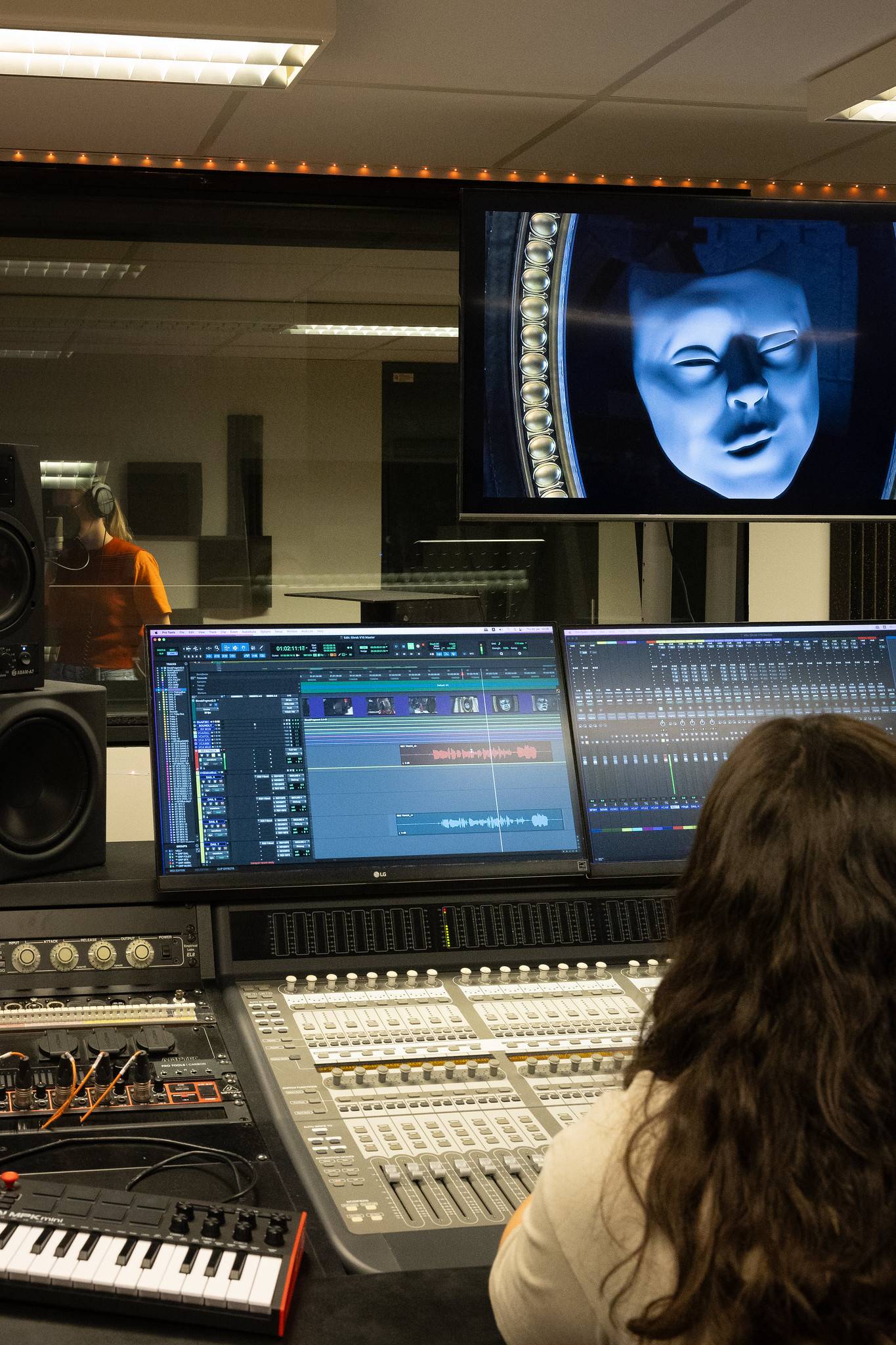
In our audiovisual workshops you enter a professional environment where image and sound come together.
You work in spacious film studios equipped with sound absorbing materials, suitable for both large-scale productions and intimate recordings. Combined with the camera, lighting and audio equipment available through the equipment lending service, you have everything you need to realise your audiovisual ideas both technically and creatively.
From recording to editing and colour grading: all spaces and equipment are tailored for students who want to develop their audiovisual projects with strong technical and creative skills.
As a LUCA student, you have access to every workshop across all LUCA campuses.
Welcome!
Interested in this course?
Application & entry requirements
Who can apply?
FilmMemory is aimed at students from all over the world with a bachelor's degree (BA) in Audio-visual Arts, Film studies, Communication Studies, Arts, History, Cultural Studies or related subjects such as Archival Studies, Heritage Studies or Museology. Other degrees (of at least EQF Level 6) may be accepted from applicants with a convincing application package and upon completion of an outstanding application assignment. Applicants without such a degree must demonstrate a recognised equivalent level of learning according to national legislation and practices in the degree-awarding countries/institutions.Candidates eligible for scholarships are students who have obtained a primary higher-education degree or can demonstrate a recognised equivalent according to national legislation and practices of the degree-awarding country. While this condition must necessarily be fulfilled at the time of enrolment, the Consortium accepts scholarship applications from students in the last year of their first higher education degree.
More information about the admission requirements
More information about the admission procedure
Deadlines & interviews
You can apply until Tuesday, January 20 2026 at 11.59 P.M. (CET). Online videoconferencing interviews with selected candidates will be held from March 9 until March 13, 2026.
For more information and deadlines visit www.filmmemory.eu/application/call-for-applicants.
Where do you have class?
Facilities & campus life
- 1st semester: Belgium (LUCA School of Arts, Brussels)
- 2nd semester: Portugal (ULHT, Lisbon)
- 3rd semester: Ireland (IADT, Dublin)
- 4th semester: distributed over the four partner universities Brussels, Lisbon, Dublin, Tallinn
Further studies and career
FilmMemory will play a significant role in providing specialists for audio-visual archives, cinemas, festivals, film funds, journals, museums, digital image processing labs, distribution companies, production companies, publishing/press agencies, and government agencies, where this kind of expertise, and associated skill sets, are in increasingly high demand.
Interested in this course?
Quality is LUCA’s driving force
If the fundamental attitude of the policy plan implies that ‘quality is our driving force’, and that every aspect of the policy can be assessed against this, then LUCA undeniably aims to build and nurture a strong quality culture: a culture based on trust in people with talent and expertise, and aimed at valuing, inspiring, and improving.
The formal quality framework for study programmes within LUCA was named KOPERA, which stands for: Critically Analyzing the Quality of Study Programmes with Peers in Self-Direction.
For KOPERA, LUCA starts from a vision of quality assurance that stems from trust and is aimed at valuing, inspiring, and improving.
During the six-year KOPERA cycle, each study programme receives a panel of critical friends who review the implementation of the quality characteristics and examine how the programme contributes to the general LUCA policy.
The culmination of KOPERA is the ultimate assurance of programme quality. The core question here is: "does the study program have a good quality culture that follows the ‘plan-do-check-act’ cycle?"
LUCA publishes a quality sheet for every study program. You can find this on the 'Quality Assurance' page.
#WeArt